
How Smoking Affects Female Hormones & The Menstrual Cycle
What the Research Says — No Panic, Just Peer-Reviewed Data
🩸🚬 This isn’t a scare article. It’s a data-driven look at what smoking actually does to female reproductive hormones and menstrual health — based on large-scale studies, systematic reviews, and meta-analyses involving thousands of women. The short answer: yes, smoking significantly impacts hormones and cycle regularity. But the “how” and “how much” matter. This article breaks down the numbers on estrogen, progesterone, ovarian reserve, cycle changes, and what happens when you quit.
📊 Ovarian Reserve: The Largest Study to Date
A landmark 2024 study published in Human Reproduction analyzed data from 8,340 women aged 21-45 in the United Kingdom [citation:1]. This is one of the largest studies examining smoking and ovarian reserve markers:
- Lower Anti-Müllerian Hormone (AMH) in smokers and vapers across all age groups, with statistically significant differences at ages 31-35: 20.73 pmol/L in smokers vs. 25.37 pmol/L in non-smokers (p = 0.003) [citation:1].
- Higher Follicle-Stimulating Hormone (FSH) in smokers across all ages — significantly elevated in women aged 21-25: 8.01 IU/L in smokers vs. 6.87 IU/L in non-smokers (p = 0.02) [citation:1].
- Vaping also showed negative effects — women aged 36-40 who vaped had significantly lower AMH: 13.65 vs. 16.88 pmol/L (p = 0.01) [citation:1].
The takeaway: Both smoking and vaping are associated with reduced ovarian reserve, meaning accelerated depletion of eggs. This can lead to earlier menopause and reduced fertility window.
📉 AMH Levels in Smokers vs. Non-Smokers (Ages 31-35)
Data from 8,340 women, Human Reproduction, 2024 [citation:1]
🩸 Hormonal Changes: What Smoking Does to Estrogen, Progesterone & Androgens
Estrogen & Progesterone
The 2010 Surgeon General’s report compiled extensive evidence on smoking and reproductive hormones [citation:3]. Key findings include:
- Estradiol (estrogen) decreases in the luteal phase — smokers showed 29% lower levels (95% CI: 10-43%) compared to non-smokers [citation:3].
- Progesterone decreases — a study of 684 fertile women found plasma progesterone decreased by 15% in smokers (p < 0.05) [citation:3].
- Estrogen metabolism shifts — smokers show a 50% increase in 2-hydroxylation (p < 0.001), a metabolic pathway that produces weaker estrogen metabolites [citation:3].
What this means: Lower progesterone and altered estrogen metabolism may contribute to menstrual irregularities, heavier bleeding, and increased breast cancer risk (due to altered estrogen breakdown).
Androgens (Testosterone & DHEA-S)
A 2022 systematic review and meta-analysis of 19 studies found [citation:5][citation:10]:
- Significantly increased testosterone levels in smokers (standardized mean difference 0.14; 95% CI: 0.0005-0.29) [citation:5].
- Significantly increased DHEA-S (dehydroepiandrosterone sulfate) in smokers across all menstrual phases (SMD 0.12; 95% CI: 0.01-0.22) [citation:5].
- A 2012 study found smokers had higher free testosterone and a higher free testosterone index, suggesting smoking may induce hyperandrogenism in some women [citation:4].
What this means: Elevated androgens in women can contribute to acne, hirsutism (excess hair growth), irregular cycles, and polycystic ovary syndrome (PCOS)-like symptoms.
📅 Menstrual Cycle Changes: What Women Report
A study of 122 young women (17-20 years old) found significant differences in cycle characteristics between smokers and non-smokers [citation:7]:
- Longer menstrual cycles — smokers averaged 37.0 ± 1.9 days vs. non-smokers 28.0 ± 1.2 days (p < 0.05) [citation:7].
- Longer menstruation duration — smokers bled for 8.5 ± 1.3 days vs. non-smokers 3.5 ± 1.2 days (p < 0.05) [citation:7].
The takeaway: Smoking is associated with longer, more irregular cycles and heavier/longer bleeding. The study authors note that while causality isn’t proven, the association is strong [citation:7].
😔 Smoking and Premenstrual Syndrome (PMS)
A meta-analysis published in Frontiers in Psychiatry pooled data from 13 studies to examine the smoking-PMS link [citation:8]:
- Smoking was associated with a 56% increased risk of PMS overall (OR: 1.56; 95% CI: 1.32-1.85) [citation:8].
- For Premenstrual Dysphoric Disorder (PMDD) — a more severe form — the association was much stronger: 215% increased risk (OR: 3.15; 95% CI: 2.20-4.52) [citation:8].
- The effect was consistent across different regions and study designs [citation:8].
What this means: Women who smoke are significantly more likely to experience moderate-to-severe premenstrual symptoms, including mood disturbances, irritability, and physical discomfort.
🔄 The Cycle-Craving Connection: Why Quitting Is Harder at Certain Times
Research from the University of Montreal found that nicotine cravings vary significantly across the menstrual cycle [citation:2]:
- Cravings are strongest in the early follicular phase (just after menstruation ends) — when estrogen and progesterone levels are at their lowest [citation:2].
- Cravings are weakest in the mid-luteal phase (about two weeks before the next period) — when estrogen and progesterone are higher [citation:2].
Practical implication: Women trying to quit smoking may have better success if they time their quit attempt to the mid-luteal phase (days 19-24 of a 28-day cycle), when withdrawal symptoms may be less intense [citation:2].
⏰ Earlier Menopause: The Accelerated Aging Effect
The Surgeon General’s report documented clear effects on FSH, a key marker of ovarian aging [citation:3]:
- FSH increased 14-21% in smokers (p = 0.03) in a study of 224 women aged 26-50 [citation:3].
- FSH increased 66% in current smokers (95% CI: 28-116%) in a study of 290 women aged 38-49 [citation:3].
- Dose-response effect — women smoking 10-20 cigarettes/day had a 76% increase in FSH [citation:3].
What this means: Elevated FSH is a marker of diminished ovarian reserve and approaching menopause. Smokers typically reach menopause 1-2 years earlier than non-smokers [citation:3].
📌 Prolactin: Another Hormone Affected
A study of 684 healthy fertile women found that smokers had 20% lower prolactin levels (p < 0.002) [citation:3][citation:9]. Prolactin plays a role in lactation, breast health, and menstrual regulation. Lower prolactin may have unclear clinical significance, but it’s another example of smoking’s widespread hormonal effects.
📌 Honest Summary (No Spin, No Panic)
Does smoking affect female hormones and the menstrual cycle? Yes — the evidence is clear and consistent across multiple large-scale studies [citation:1][citation:3][citation:5].
What changes? Lower AMH (reduced ovarian reserve), elevated FSH (accelerated ovarian aging), decreased progesterone, altered estrogen metabolism, increased testosterone, longer cycles, heavier bleeding, and higher risk of PMS/PMDD.
How much? Effect sizes vary: AMH ~18% lower in smokers at certain ages; PMS risk 56% higher; PMDD risk 215% higher; cycles about 9 days longer.
Are the effects reversible? Some effects (cycle regularity, hormone levels) may improve after quitting. However, ovarian reserve depletion is cumulative and irreversible — the eggs lost to smoking cannot be recovered.
Does this mean every smoker has problems? No. Many women who smoke have regular cycles and conceive without difficulty. But on a population level, smoking significantly increases the risk of menstrual disorders, fertility challenges, and earlier menopause.
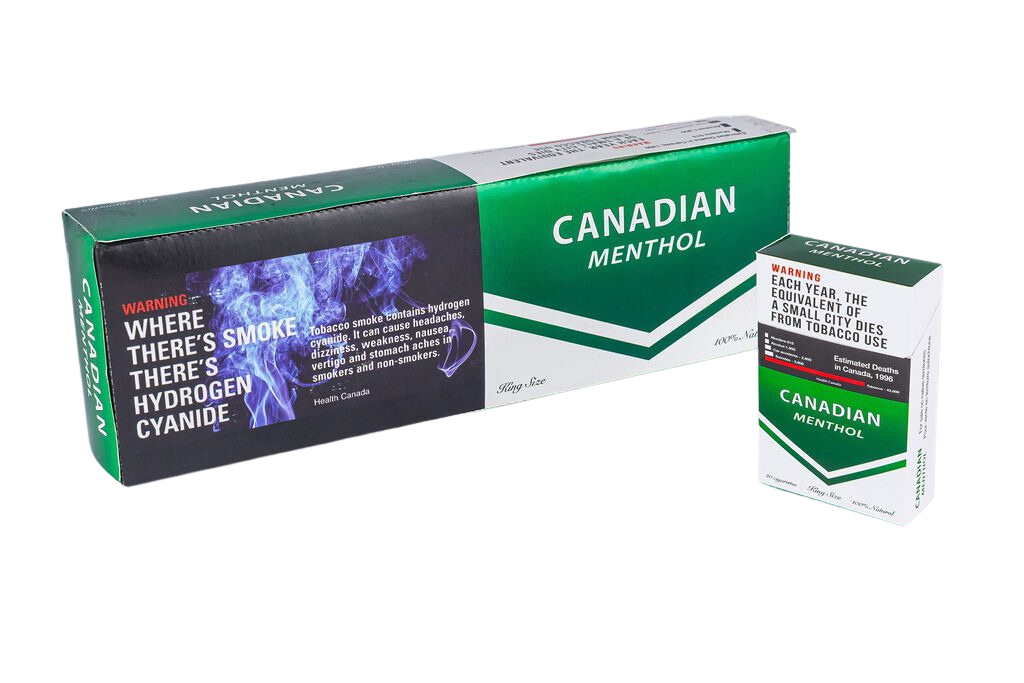
🛒 Popular Native Cigarettes on Cigstore.ca
Affordable cartons for Canadian smokers — starting at just $29.




📚 You Might Also Find These Articles Interesting
Smoking & Male Fertility
How smoking affects sperm count and DNA — the male side.
Smoking and Appetite
How nicotine affects hunger and metabolism.
Smoking & Taste
How cigarettes alter perception of food and drink.
Menthol & Male Potency
How menthol cigarettes affect erectile function.
Are Native Cigarettes Less Harmful?
What the science actually says.
🚚 Fast & Reliable Shipping Across Canada
$29 flat shipping on all orders under $290
Free shipping on orders $290 or more – anywhere in Canada
📦 Shipped via Canada Post, Purolator, FedEx, or UPS – carrier selected based on your location for fastest delivery.
Age verification required upon delivery (19+). Indigenous-owned – rooted in tradition, delivered with trust.
📚 Knowledge is power. Smoke smarter.
Whether you’re cutting down, quitting, or just want affordable native cigarettes — Cigstore.ca has you covered. $29 flat shipping. FREE over $290.
🛒 Shop Native Cigarettes →References: 2024 Human Reproduction study (n=8,340 women) [citation:1]; University of Montreal cycle-craving research [citation:2]; 2010 Surgeon General’s Report on smoking and reproductive hormones [citation:3]; Dušková et al., Physiol Res 2012 [citation:4]; Ihenacho et al., Nicotine Tob Res 2022 meta-analysis [citation:5][citation:10]; Vlasova & Tsirkin, Russian study on cycle length [citation:7]; Frontiers in Psychiatry PMS meta-analysis [citation:8]; Berta et al., Horm Res 1992 [citation:9].